
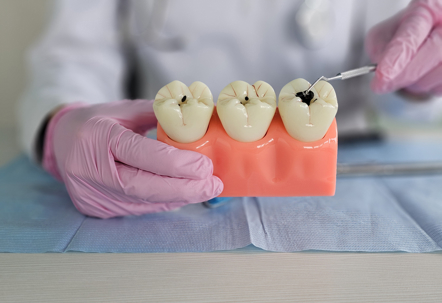
A dentist flagged a cavity at your last visit, then life got busy and scheduling the filling slipped down the list. That's a common moment, and a cavity doesn't turn into a crisis for everyone overnight. But it also doesn't fix itself once decay has started.
This guide from our team at ProHEALTH Dental walks through how decay progresses, why the timeline looks different for each patient, and what a cavity can become if left untreated for too long.
A small cavity is easiest to treat before it progresses. Request an appointment online to schedule an exam and get it evaluated.
How an Untreated Cavity Progresses
Decay starts in the enamel, the tooth's hard outer layer. At this stage, a cavity is a small area of damage that hasn't reached the tooth's inner layers yet.
If the cavity goes untreated, decay moves into the dentin, the softer layer beneath the enamel. Dentin breaks down faster than enamel, which is usually when sensitivity or discomfort starts to show up.
If decay continues past the dentin, it can reach the pulp, the soft tissue inside the tooth that holds the nerves and blood vessels. Once bacteria reach the pulp, a filling alone can no longer treat the tooth.
If left untreated, the infection can spread beyond the tooth and form a dental abscess, a pocket of pus that requires prompt treatment.
Why There's No Universal Timeline for How Fast This Happens
How quickly a cavity progresses is different for every patient. Enamel strength, saliva composition, oral hygiene habits, and diet all play a role in how fast decay spreads.
Saliva is one of the mouth's natural defenses against decay, and its composition varies from person to person. That's one reason two patients with a similar-looking cavity can end up with different outcomes.
Because of that variability, there's no fixed timeline that applies to every case. Your dentist evaluates each cavity individually during an exam rather than relying on a general timeframe.
What Untreated Decay Can Turn Into
Once decay reaches the pulp, root canal treatment may be needed to remove the infected tissue and save the tooth.
If the damage or infection progresses beyond what a root canal can address, extraction may become the only option left for that tooth.
Your dentist evaluates the tooth and determines which path applies. That's not a decision a patient makes on their own.
For a closer look at how that decision gets made, our blog on Saving Your Natural Tooth: Root Canal vs. Extraction walks through what a root canal involves and how it compares to extraction.
Signs a Cavity Might Be Getting Worse
A cavity doesn't always come with an obvious signal, but a few changes are worth paying attention to.
Watch for these signs that a cavity may be progressing:
Increased sensitivity to hot, cold, or sweet – Especially if it lingers after the food or drink is gone.
Pain when biting down or chewing – On the same side as the cavity.
A visible dark spot, hole, or rough patch – On the surface of the tooth.
A toothache that comes and goes, or one that's now constant – Either pattern is worth mentioning to your dentist.
Swelling or tenderness in the gum near the tooth – Which can point to infection spreading beyond the enamel.
These signs point to a cavity that needs an evaluation, not a diagnosis you can make on your own. The next step is to schedule an exam with your dentist, not to wait to see if it resolves.
Why Addressing It Now Is the Simpler Option
A filling treats a cavity at its least invasive stage, before decay has reached the dentin or pulp.
Waiting risks the potential of more involved treatment later. Addressing a cavity early, while it's still a straightforward filling, is generally simpler than treating it after it's progressed.
Our general dentists evaluate and treat cavities as part of routine care, and refer more complex cases to a specialist when appropriate.
The Best Time to Address a Cavity Is Now
A cavity moves through stages, from the enamel to the dentin to the pulp, and the pace depends on the individual patient. Getting it evaluated and filled now keeps the simplest option on the table.
If a dentist has flagged a cavity for you, or you've noticed any of the signs above, our general dentists at ProHEALTH Dental are easy to reach for an exam.
Book an appointment online to schedule a cavity exam. We see patients for general dentistry across New York and New Jersey.