A week of houseguests or a red-eye flight has a way of surfacing things you'd otherwise never hear about yourself. If you've searched for an oral appliance for sleep apnea because a CPAP machine sits unused in your closet, or because someone finally said something about the snoring, you're not the first person to land here this summer.
Dental sleep treatment starts with a conversation with us. During your initial visit, we have you complete a sleep questionnaire. Based on your responses, we may identify signs that suggest you should see a physician for a formal sleep evaluation. If your doctor diagnoses you with obstructive sleep apnea and recommends an oral appliance as part of your treatment, you'll return to us to be fitted and receive ongoing care.
If loud snoring, gasping, or daytime exhaustion sound familiar to you, mention them at your next visit. Request an appointment online to ask about dental sleep treatment.
What Does Dental Sleep Treatment Actually Involve?
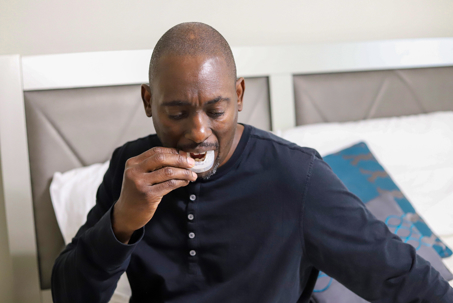
A custom oral appliance isn't the mouthguard you'd pick up at a drugstore. A drugstore mouthguard cushions your teeth and lets your jaw rest wherever it lands. An oral appliance for sleep apnea, often called a mandibular advancement device, holds your lower jaw slightly forward on purpose, which keeps your airway open while you sleep. One protects. The other repositions.
The American Academy of Sleep Medicine and the American Academy of Dental Sleep Medicine jointly issue a guideline stating that the device must be custom-made, adjustable, and provided by a trained dentist. Not fabricated once and forgotten. Adjusted, as needed, by someone qualified to adjust it.
How Do You Know If You Should Be Screened?
Some signs are easy to miss until someone else points them out. If your partner has mentioned that you snore loudly, gasp, or seem to stop breathing for a few seconds at a time, that's worth paying attention to.
Watch for these common signs:
Loud, irregular snoring – Especially when it's followed by a pause and then a gasp or snort.
Waking up gasping or choking – Even briefly, and even if you don't fully wake up.
Morning headaches or a dry mouth – That show up before you've even gotten out of bed.
Daytime sleepiness or trouble focusing – Despite spending enough hours in bed the night before.
Every preventive visit with us includes an annual sleep health questionnaire. That's how a lot of patients get flagged before they've even brought up the topic themselves.
Why Does a Physician Need to Be Involved Before Treatment?
If your questionnaire or exam raises a concern, we refer you to a physician who focuses on sleep medicine. If that evaluation confirms sleep apnea, the physician typically prescribes treatment first, often CPAP. Some patients can't tolerate it, or want something easier to travel with, and come back to us for an oral appliance instead.
The appliance is covered through medical insurance, not dental insurance, and that coverage generally depends on treatment starting with your physician. Patients who come to us without a referral can still be treated, just at their own cost. And if you've already been diagnosed by an outside sleep physician, that path works too.
Who Is Dental Sleep Treatment Really For?
This isn't only for people who've already given up on CPAP, though that's the most common way patients arrive at it. A widely cited 2008 review in the Proceedings of the American Thoracic Society found that, depending on how adherence is measured, between 46% and 83% of CPAP patients don't use it consistently enough to be considered adherent.
If a mask and machine haven't worked for you, or you'd rather pack something that fits in a dopp kit than a machine that needs an outlet, an oral appliance is worth asking about. Whether it's right for your case is a decision your physician and dentist make together. Not something to sort out alone.
What Makes Our Dental Sleep Team Different?
Dr. Arthur Feigenbaum, DMD, D.ABDSM, directs our dental sleep treatment program and sees patients in Lake Success, Huntington, and Yorktown Heights. D.ABDSM means Diplomate of the American Board of Dental Sleep Medicine, a credential that requires testing on oral appliance therapy specifically, not general dentistry. That's why patients from our other offices get referred to him for this treatment instead of being fitted locally.
Talk to Your Dentist About Your Sleep
If snoring, gasping, or daytime exhaustion have been part of your routine long enough that you stopped mentioning them, this summer's disrupted schedule is as good a reason as any to finally bring it up. ProHEALTH Dental's preventive visits already include the sleep questionnaire that starts that conversation, and our credentialed dental sleep team takes it from there alongside your physician.
Ready to talk about your sleep? Schedule an appointment online to discuss dental sleep treatment with your dentist at your next visit.