
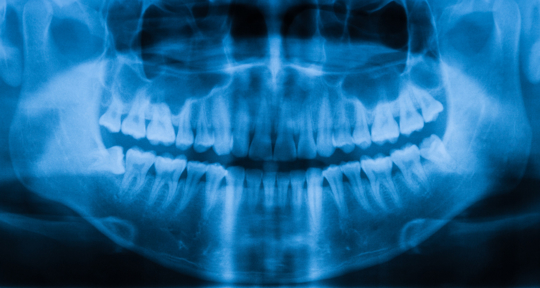
A dental visit goes beyond just cleaning your teeth. Every part of a routine checkup serves a specific purpose, and understanding what your care team is doing and why makes the experience feel less like a mystery and more like a system working in your favor.
If you’ve ever wondered why X-rays are necessary when your teeth look fine, what your hygienist is removing, or what your dentist is checking for during the exam, this breakdown is for you.
Book an appointment online at a ProHEALTH Dental location near you in New York or New Jersey.
The Cleaning — Removing What Brushing Cannot
Consistent brushing and flossing significantly improve your oral health. However, they do not eliminate everything. Plaque that builds up in hard-to-reach areas hardens into tartar, also known as calculus. Once plaque turns into tartar, neither a toothbrush nor floss can remove it. Professional tools are necessary.
During a dental cleaning, your hygienist removes plaque and tartar from all tooth surfaces, including at and below the gumline. Afterward, your teeth are polished to reduce surface roughness where plaque tends to accumulate between visits.
Tartar buildup is the main cause of gum disease and leads to cavities. Regular cleanings reduce bacteria in your mouth and help keep your gums healthy. These cleanings also give your hygienist a chance to closely examine your gums and identify any concerns to discuss with the dentist during your appointment.
X-Rays — Seeing What a Visual Exam Cannot
Even a thorough visual inspection has its limits. X-rays reveal things that cannot be seen through looking alone: decay forming between teeth, bone loss along the roots, infections near the base of a tooth, cysts, and the position of teeth that have not yet erupted.
For patients with good dental health, X-rays are usually recommended every 12 to 18 months. Patients with gum disease, a history of frequent cavities, or ongoing treatment might need them more often based on your dentist's advice.
Dental X-rays use a very low level of radiation, comparable to the natural background radiation a person absorbs in a normal day. Lead aprons and thyroid collars are used to minimize exposure further.
Without X-rays, decay between back teeth and bone loss often go unnoticed until they require significant treatment. X-rays enable early detection and intervention.
The Exam — What Your Dentist Is Actually Looking For
Most people think of the dental exam as just the part where a dentist looks at your teeth. The reality is much broader. Your dentist assesses your gums, bite alignment, jaw, soft tissues inside your mouth, and your overall oral health.
During the exam, your dentist looks for:
Early decay between teeth – Cavities that form between tooth surfaces rarely cause pain in their early stages, which means they often go undetected without a thorough exam and supporting X-rays.
Gum recession or inflammation – Changes to your gumline and tissue health signal early-stage gum disease before it advances and affects the bone supporting your teeth.
Signs of grinding (bruxism) – Worn enamel, flattened tooth edges, and jaw tenderness point to grinding habits that can cause long-term damage if left unaddressed.
Changes in bone support – Bone loss around teeth progresses gradually and typically without symptoms. The exam, combined with X-rays, allows your dentist to monitor changes.
Soft tissue abnormalities – Changes in the color, texture, or appearance of the soft tissue inside your mouth warrant close attention.
At ProHEALTH Dental, the exam also includes two screenings that expand the scope of your visit. An oral cancer screening involves a visual inspection inside your mouth to check for any changes that may need follow-up. A sleep health questionnaire helps identify potential issues related to any obstructions to your breathing while you sleep so that can be addressed with the proper medical professional and prevent other health risks from arising.
Many dental issues are asymptomatic in their early stages. The exam detects them before they cause pain or need more complex treatment later.
How These Steps Work Together
A routine checkup follows a set order, and each step informs the next.
Your hygienist first cleans your teeth, removing buildup that has accumulated between visits and closely examines your gum health and tooth surfaces. On visits when X-rays are necessary, those are taken before the dentist's exam so your dentist has a complete picture from the start. The dentist then examines your teeth and mouth, reviewing the hygienist's observations during the cleaning and the X-rays.
The cleaning surfaces are those present at the gumline and above. The X-rays reveal what is occurring between the teeth and below the surface. The exam connects both, providing your dentist with the full context needed to assess your oral health accurately and suggest next steps based on what they actually find.
Together, these three steps give your dentist a complete view of your oral health at that point in time and a documented baseline to measure changes against at your next visit.
Your Oral Health, Seen Completely
A dental check-up and cleaning is proactive, not reactive. It is a system designed to protect your oral health long-term by identifying issues early, before they become more complicated. Your dentist will review findings with you at each visit and suggest the next steps based on what they see.
Ready to schedule? Book an appointment online. Our team at ProHEALTH Dental serves patients across New York and New Jersey and will guide you through each step of your visit.